Children notice more than adults often assume. They notice the hushed phone calls, the relative who suddenly looks tired, the way a parent's attention drifts at dinner. When nobody explains what is happening, they fill the gaps themselves — and what they invent is usually worse than the truth, or at least scarier.
Telling a child that someone they love is ill is one of the harder conversations a family will have. It is also one of the most useful. Handled with honesty and a bit of preparation, it gives a child something solid to stand on: words for what they are feeling, permission to ask questions, and the reassurance that they are still being looked after. Here is how to go about it.
Before you sit down with a child, spend ten minutes deciding what you are going to say. Not a script, but the three or four facts you want them to walk away with. You may be frightened yourself, and it is fine for a child to sense that something is serious — what helps is when the adult is steady enough to hold the conversation together.
Ask yourself two questions. What does this child already know or suspect? And what does this child actually need to know right now? Those answers differ enormously by age. A five-year-old needs to understand that Grandma is sick and that it is not their fault. A twelve-year-old, hearing the same news, may want to know whether treatment means missed school pickups, who will drive them to football, and whether the person will die. Both children deserve a truthful answer, but not the same sentence.
If you are the partner or adult child of the person who is ill, consider whether you are the best person to lead the conversation, or whether it should be shared with someone steadier that day. It is also worth agreeing in advance with other adults in the household on the basic facts, so a child does not get three versions of the same news.
Pick a time when nobody is rushing out of the door and the child is not already tired or hungry. Early evening, after dinner, on a day without a big event the next morning, is usually better than a Sunday night before school. Choose somewhere familiar — the kitchen table, a sofa, a walk — rather than a formal "we need to talk" summons, which signals crisis before you have said a word.
If there are several children, it can help to tell them together so nobody feels excluded, then speak to each one separately afterwards. Children listen differently in a group, and the quiet one often has the questions.
The single most common mistake is over-explaining with medical detail in the belief that information equals honesty. The second most common is saying nothing and hoping the child will not notice. Aim for the middle: plain words, short sentences, no euphemisms that hide the meaning.
Keep it to one or two sentences and connect it to what the child can see. "Daddy has a sickness in his tummy. The doctors are giving him medicine to help. He still loves you very much, and you did nothing to cause it." Repeat the same simple explanation over the next days and weeks, because young children need to hear it more than once. Avoid phrases like "going to sleep" or "we lost Grandpa" — a small child can take these literally and become frightened of bedtime.
Children this age want causes and consequences, and they will usually ask. Give the name of the illness if you can and explain simply what it does and what treatment involves. "Mum has something called breast cancer. It is not catching. She is having treatment that will make her tired for a while, and I will be doing the school run." Expect the practical questions — who picks me up, will she be at my birthday, can I still have friends over — and answer them concretely. Let them know that feeling angry, sad or fine are all allowed, and that being fine sometimes is normal.
Teenagers can usually handle the fuller picture, including uncertainty. What they hate is being managed or kept in the dark while overhearing pieces of conversation. Be direct, admit what you do not know yet, and tell them what you will update them on. They may react with apparent indifference or by retreating to their room; that is not proof they do not care. Leave the door open and check in later.
Their questions are rarely the ones adults prepare for. They want to know whether they caused it, whether they can catch it, who will look after them, and whether the family will still be able to do the things they love. Answer those, even if they seem trivial next to the illness.
The first conversation is not the whole conversation. Children process in instalments, often weeks later, and their questions will come at inconvenient moments — in the car, at bath time, halfway through a supermarket shop. Try to treat those moments as welcome rather than interrupting. A short answer now is worth more than a postponed proper talk.
Check in every week or so without interrogation: "Anything you've been wondering about?" Watch for changes in sleep, appetite, schoolwork or friendships, which are often how worry shows up in children who would never say they were worried. Drawing, play and stories can give younger children a way to express what they cannot explain.
If a child becomes withdrawn, persistently anxious, or starts behaving very differently over several weeks, speak to their GP or school about support. Serious illness in a family is a lot to carry, and asking for help for a child is not overreacting. For anything to do with the illness itself, medical questions go to the treating team rather than being inferred at home.
Write down the three facts you will share and one sentence about what stays the same. Sit somewhere calm, with time afterwards. Use plain words, avoid "going to sleep" and similar phrases, and say clearly that the child is not to blame. Stop talking sooner than feels natural and let them ask. Tell them when you will talk again. Then keep the rest of the evening ordinary — dinner, a bath, a story — because ordinary is exactly what a frightened child is looking for. And if you get it wrong, or burst into tears halfway through, that is survivable. You can come back tomorrow and say, "I want to explain that better." Children remember being told the truth far longer than they remember the wording.
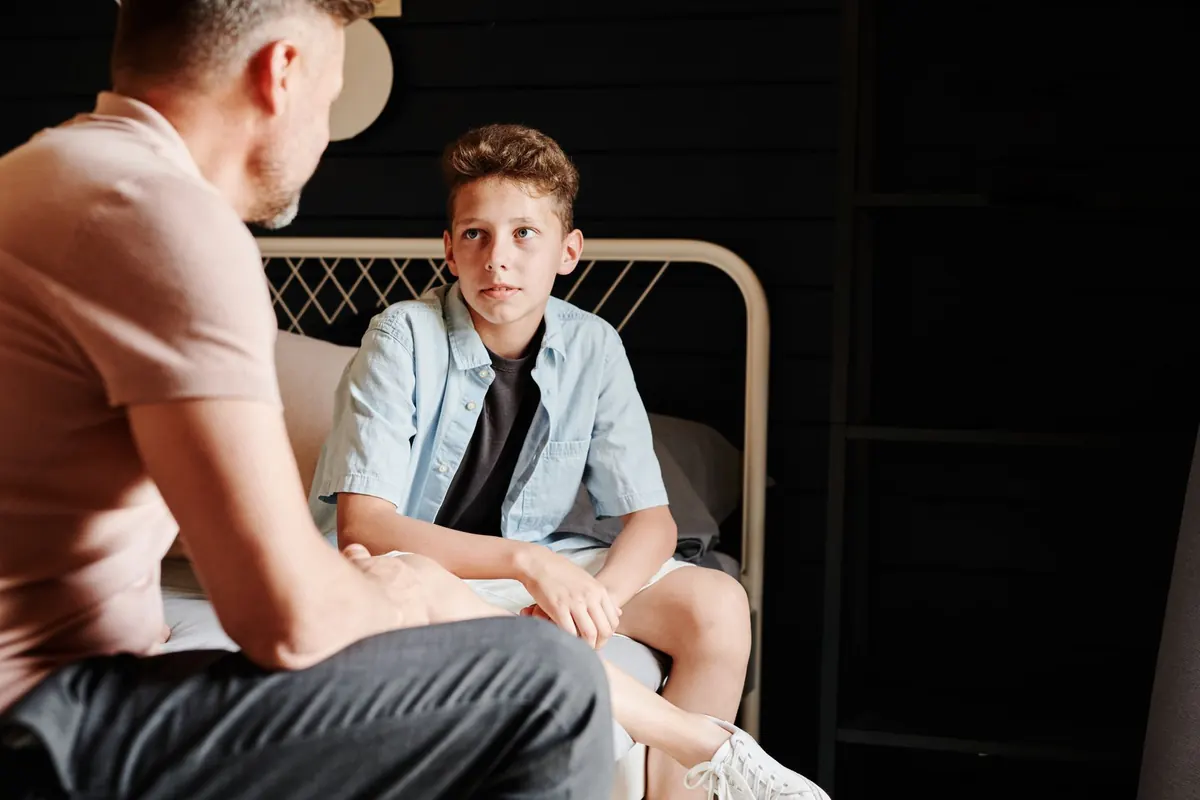
Photo: Julia M Cameron / Pexels